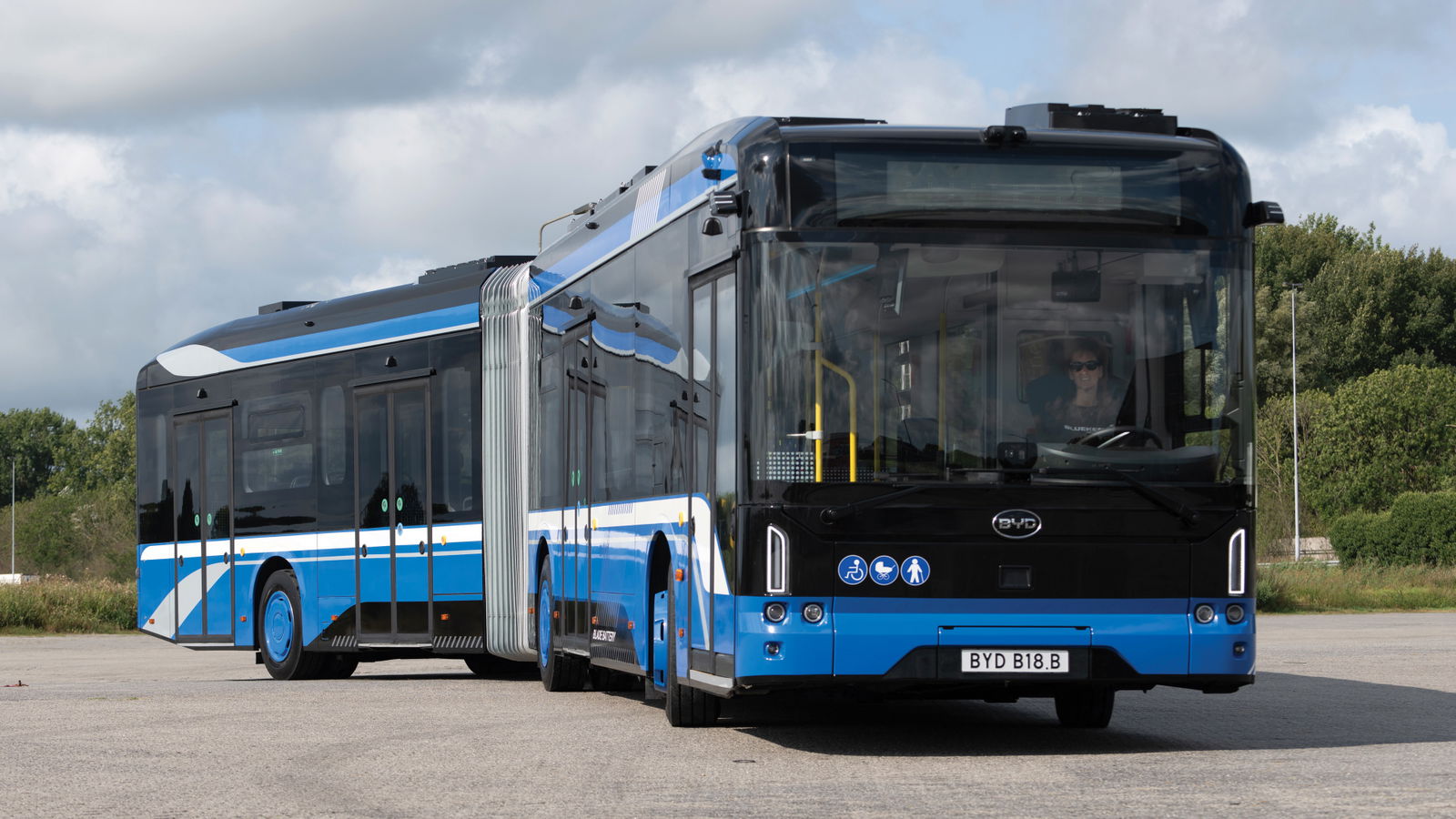
European bus manufacturing under pressure from China: ACEA says the next two years could determine the sector’s future
The European bus market is moving towards electrification at an unprecedented pace, but Chinese manufacturers are capturing an increasingly large share of the economic and industrial benefits of the transition. While around 60% of new urban buses are now battery-electric, Chinese brands’ share of the EU electric bus market reached 28% by 2025, rising to 32% among electric urban buses. In its position paper, the European Automobile Manufacturers’ Association (ACEA) warns that the competitive position of European bus manufacturing is deteriorating faster than in any other area of the vehicle industry. The organisation says urgent industrial policy intervention is needed, otherwise Europe could lose a substantial proportion of its manufacturing, development and technological capacity related to electric public transport in the long term.
Among the members of ACEA, which represents 17 leading passenger car, light commercial vehicle, truck and bus manufacturers in the European vehicle industry, are major commercial vehicle producers including Daimler Truck, Iveco Group, the TRATON Group, which incorporates MAN and Scania, and the Volvo Group. According to the organisation’s position paper, bus manufacturing has now become an area of strategic importance for European industrial policy. A distinctive feature of the sector is that a substantial part of demand is linked to procurements financed directly from public funds, meaning that EU and national regulation fundamentally influences not only the achievement of environmental objectives, but also the conditions of competition between manufacturers.
The scale of the issue is well illustrated by the fact that around 680,000 buses are currently in operation in the European Union, a substantial proportion of which carry passengers under public service contracts. The urban bus market depends almost entirely on public procurement and public funding, while private operators also play a decisive role in the regional and long-distance segments. ACEA therefore considers it particularly contradictory that an increasing share of vehicle procurements supported by European taxpayers’ money is being won by manufacturers from outside Europe.
Europe electrifies as China gains an ever larger market share
According to ACEA data, 22,590 new buses were registered in the European Union in the first half of 2026, representing growth of 22.7% compared with the same period of the previous year. The expansion was particularly substantial in Poland, where registrations rose by 78%, while increases of 51.6% were recorded in Italy and 21.6% in both Germany and France. Of the larger markets, only Spain saw new bus registrations decline, by 8.5%.
In parallel with this growth, the electrification of urban buses has also accelerated, with EU clean vehicle procurement requirements, municipalities’ climate commitments and carbon dioxide emissions requirements applicable to manufacturers playing a decisive role. However, the speed of electrification is bringing an increasingly stark industrial-policy contradiction to the surface.
In 2025, Chinese brands held around 9% of the European Union’s overall bus market, but already accounted for 28% of the electric bus market. Looking exclusively at urban buses, their share was 20%, while among fully electric urban vehicles it stood at 32%. By comparison, passenger cars manufactured in China accounted for only 7% of EU new car sales in the same year. This means that Chinese manufacturers’ advance is considerably more advanced in buses than in passenger cars, and is strongest precisely in the segment whose development is driven directly by European public money and regulatory incentives.
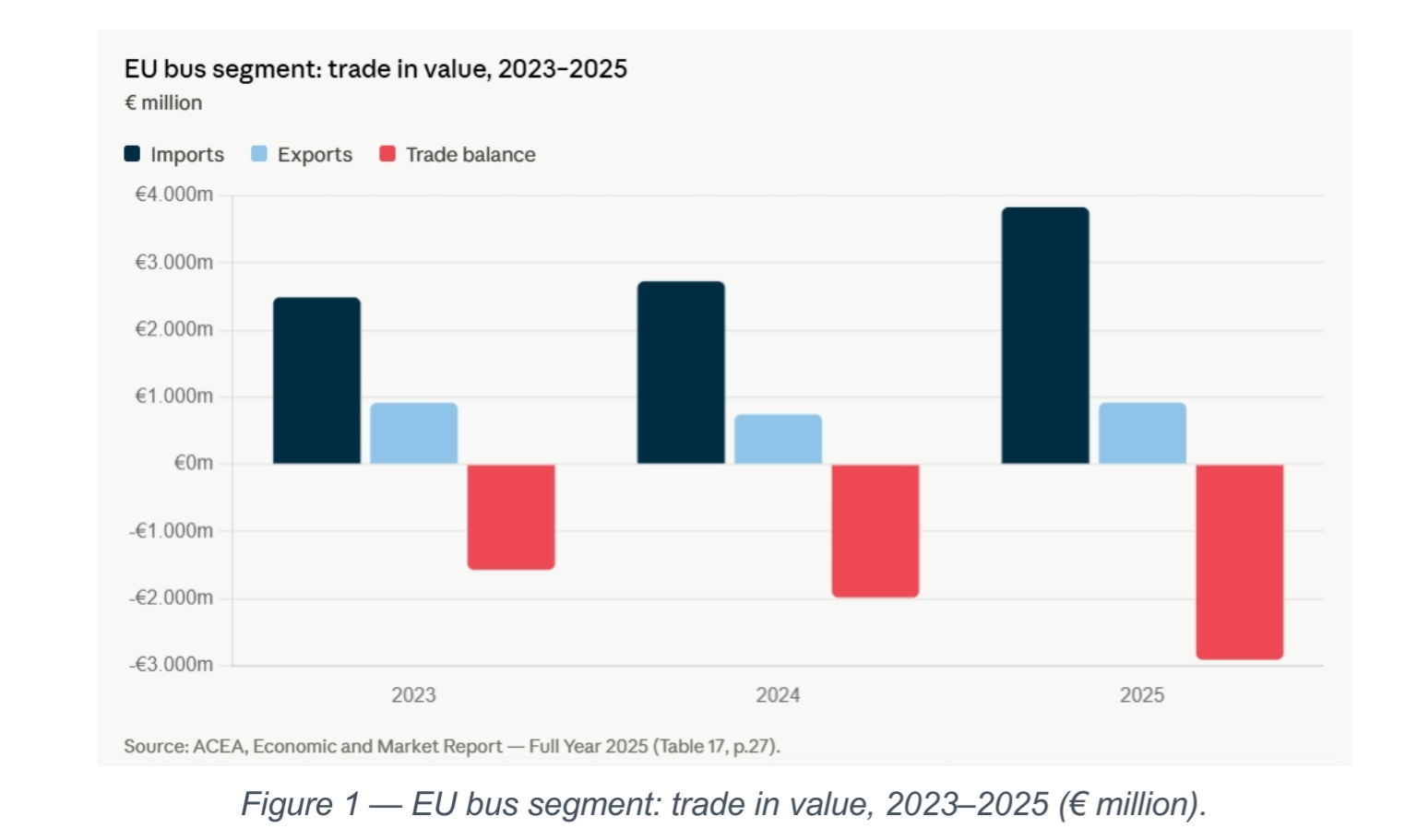
Developments in the trade balance also point to an unfavourable trend. The European Union’s external trade deficit in buses rose from EUR 1.6 billion in 2023 to EUR 2.9 billion by 2025, increasing by 46.8% in the latter year alone. Meanwhile, the value of bus imports from China exceeded EUR 1 billion for the first time, nearly 70% higher than a year earlier.
ACEA stresses that Europe’s industrial base remains substantial. More than 38 bus assembly plants operate in 12 EU Member States, with the most important manufacturing centres located in Poland, France, Germany, Italy, Spain, the Czech Republic, the Netherlands, Belgium and Portugal; buses are also manufactured in Hungary, Lithuania and Romania. EU production still increased by 8.9% in 2025. However, the organisation warns that the mere existence of manufacturing capacity does not guarantee its long-term survival. Lost orders affect not only assembly plants, but also European suppliers, engineering development centres, component manufacturers and research and development activities.
Chinese manufacturers’ advantage is not solely lower prices
ACEA specifically addresses why Chinese bus manufacturers are regularly able to submit more favourable bids than their European competitors. According to the organisation, the price difference cannot simply be attributed to European companies producing less efficiently. Indeed, based on revenue per employee, Western manufacturers generally remain more productive than their Chinese rivals. The difference is explained far more by the differing structures of the two industrial systems.
One of Chinese manufacturers’ most significant advantages is vertical integration. While European bus manufacturers typically procure major components from independent suppliers, and therefore also pay suppliers’ profit margins in their prices, several major Chinese companies manufacture key elements of their drivetrains, electronics and energy storage systems themselves, or have direct intra-group links with companies that produce them.
This is reinforced by the advantage of China’s enormous domestic market. China’s urban bus fleet has already been largely electrified, allowing manufacturers to recoup a substantial part of the costs of platform development, software and battery technology through domestic orders at an earlier stage. Vehicles intended for the European market can therefore often be based on mature designs produced in high volumes. According to ACEA, moreover, building a factory of similar capacity in China can cost up to 60% less than in Europe.
The cost advantage is further increased by state support, tax incentives, preferential financing arrangements, and lower engineering and general operating costs. According to the association, the various forms of support account for a material part of net profit at some leading Chinese manufacturers. This creates a competitive situation in which European manufacturers can struggle to overcome their disadvantage through efficiency improvements alone. If the outcome of a public procurement procedure is determined almost exclusively by the purchase price, the structural cost advantage can translate directly into contractual success.
European assembly alone does not constitute European value creation
One of the position paper’s most important findings is that the protection of European industry cannot simply be linked to vehicles’ country of origin. According to ACEA, the crucial issue is not where a bus was made in customs terms, but where the added value generated during its production, development activity and technological control are actually concentrated.
The association acknowledges that the emergence of European assembly plants operated by Chinese manufacturers may in itself be a positive development. However, this requires part of the supplier activity, engineering work and technological expertise to be brought to Europe alongside local manufacturing. If battery cells, drivetrains, electronics, software and development tasks remain outside Europe, local assembly delivers only limited economic benefits.
ACEA therefore advocates assessing the entire automotive value chain when determining European added value, including research and development, engineering activity, software development and battery-pack integration.
The position paper also contains a noteworthy finding from Hungary’s perspective. According to ACEA, there is currently only one significant bus assembly plant in the European Union belonging to a manufacturer from outside Europe, and it is in Hungary.
Delivery lead times also create a competitive disadvantage
ACEA does not dispute that European bus manufacturers have also been placed at a disadvantage in terms of delivery lead times in recent years. However, the organisation stresses that numerous exceptional circumstances simultaneously hampered European production between 2020 and 2026.
The fall in demand caused by the coronavirus pandemic led to capacity reductions, the war in Ukraine disrupted supply chains, and shortages of electronic components caused further delays. These were compounded by development and homologation tasks associated with the GSR II safety requirements applicable from mid-2024, as well as vehicle deliveries concentrated in 2025–2026 and financed from NextGenerationEU funds. All this occurred precisely when manufacturers had to adapt their entire product portfolios, plants and supplier networks to the requirements of electromobility.
According to the association, delivery times have gradually normalised since then, but certain structural disadvantages persist. European manufacturers cannot order high-value components or commit substantial manufacturing capacity for public procurements that they may not win. By contrast, Chinese companies with large and predictable domestic markets can more easily manufacture in advance.
ACEA therefore calls for longer delivery lead times, framework contracts containing binding volume commitments, consolidated orders and more uniform technical requirements. In its view, excessively short delivery deadlines can unintentionally favour suppliers that hold larger inventories or have vehicles manufactured in advance.
The association also warns that collecting procurement intentions at EU level is not sufficient in itself. Manufacturers will not undertake significant capacity expansions on the basis of forecasts alone if these are not backed by actual orders and long-term predictable financing programmes.
The situation is entirely different for long-distance coaches
ACEA particularly stresses that the electrification of urban and long-distance buses cannot be addressed using the same regulatory logic. While battery-electric propulsion has become decisive in the urban segment, the share of zero-emission vehicles among regional and long-distance buses was only 4% in both 2024 and 2025.
This is fundamentally due to operational and economic reasons. Urban buses generally operate on predetermined routes from central depots, making their charging and daily energy requirements relatively predictable. Long-distance coaches, by contrast, operate over changing routes and greater distances, without adequate public charging infrastructure, while their purchase is often financed by private businesses operating on narrow profit margins.
According to ACEA, the first European series-production lines designed to manufacture zero-emission long-distance coaches began operating in 2026. Manufacturers must currently develop and type-approve diesel and zero-emission designs in parallel, while demand for the latter does not yet allow development costs to be recouped across high production volumes. The association therefore asks legislators in the long-distance segment to focus primarily on creating the necessary operational and infrastructure conditions, rather than simply extending to this market the regulatory solutions applied to urban buses.
ACEA calls for reform of public procurement
ACEA’s action is not without precedent: in June 2026, four independent European bus manufacturers — Spain’s Beulas, Switzerland’s HESS, Poland’s Solaris Bus & Coach and the Netherlands’ VDL Bus Group — jointly called for the introduction of so-called ‘Made in Europe’ requirements favouring European added value. In the debate surrounding the initiative, the International Association of Public Transport (UITP) also expressed support for the principle of European preference, while advocating its gradual and targeted application, taking account of available manufacturing capacity, procurement costs, competition and the objectives of public transport electrification.
According to ACEA, public procurement would need to serve EU industrial-policy objectives much more strongly than it does at present if the competitiveness of European bus manufacturing is to be preserved. One of the most important tools for this is the Industrial Accelerator Act, whose provisions on European manufacturing content the organisation would tighten.
The association particularly objects to the fact that Article 11(3) of the proposed regulation would allow Member States to waive ‘Made in the EU’ requirements if their application resulted in a procurement cost difference exceeding 25%. According to ACEA, this would render provisions intended to protect European industry ineffective precisely in those procedures where Chinese manufacturers’ structural price advantage is greatest. The association therefore proposes eliminating the exemption and giving broader recognition to European added value.
It would also make it mandatory for bids in publicly funded bus procurements not to be assessed exclusively or predominantly on price. Criteria covering the vehicles’ full life cycle would include environmental, social and corporate governance requirements, security of supply, maintenance and spare-parts support, software services, cybersecurity and European research and development activity. According to ACEA, public procurement should assess not merely the one-off purchase of vehicles, but also the long-term economic and technological value that a given supplier provides to the contracting authority.
As part of the standardisation of technical requirements, the organisation also advocates using VECTO to compare buses’ energy consumption. In its view, the fact that many transport authorities still request SORT data in tenders, while VECTO is already the methodology established in EU regulation, generates unjustified additional costs. Eliminating parallel calculations could also reduce manufacturers’ administrative and development burdens.
Cybersecurity is also becoming an increasingly important consideration
The position paper also specifically addresses security risks related to connected buses. According to ACEA, the growing market share of non-European manufacturers has raised concerns in several countries over dependence on supply chains, vehicles’ digital systems and the potential transfer of sensitive data.
The organisation cites Norway as an example, where the share of new buses originating from countries not participating in security-policy cooperation rose from zero in 2018 to 65% by 2025. The Norwegian government is therefore working on public procurement guidelines that would place greater emphasis on supplier diversification, supply-chain resilience and preference for suppliers from security-policy partner countries. In certain cases, the proposals would also allow exemptions from zero-emission procurement requirements where justified by security, technical or disproportionate cost considerations.
However, ACEA does not consider it necessary to create a new, parallel set of cybersecurity rules. Instead, it regards the provisions of UN/ECE Regulation R155 as an appropriate starting point, as they already require manufacturers to identify, assess and manage supplier and IT risks through their cybersecurity management systems.
The organisation also proposes that, when Regulation (EU) 2019/1242 on CO₂ emissions from heavy-duty vehicles is reviewed by the end of 2027, security-of-supply requirements should be extended to digital and cybersecurity dependencies as well.
Competition is becoming increasingly difficult beyond Europe as well
According to ACEA, the problems facing European manufacturers are not confined to the EU market. The electric bus market is also expanding rapidly in Latin America, Africa and Asia, where European companies that had previously built strong positions with conventionally powered vehicles are facing increasing competition.
In these markets, Chinese manufacturers compete not only on favourable prices but, in many cases, also through integrated financing solutions. ACEA therefore believes that European export finance should also support comprehensive offerings that include not only the vehicles, but also charging infrastructure, financing and maintenance services.
The organisation also considers the European Union’s Global Gateway initiative an important tool. By the end of 2025, the programme had mobilised more than €306 billion, exceeding the €300 billion target set for the 2021–2027 period. According to ACEA, European added value, security of supply and European technical standards should also be taken into account in overseas public transport investments financed by the EU.
It considers cooperation with European companies operating transport services outside Europe particularly important, as this could enable EU technologies and vehicles to reach new markets. The association argues that the loss of export markets also affects the domestic competitiveness of European manufacturers: with lower production volumes, development and industrial costs are spread across fewer vehicles, further increasing unit costs.
The next two years could determine the future of European bus manufacturing
The most serious warning in ACEA’s position concerns timing. According to the association, decisions taken over the next 24 months will fundamentally influence who will be the key vehicle suppliers to European public transport in the coming decade.
Contracts awarded between now and 2030 do not merely represent one-off bus orders. They entail maintenance, spare-parts supply, software and other service relationships extending over many years, which can generate substantial revenues and technological dependencies. If a large proportion of these contracts goes to manufacturers outside Europe, this could also make it more difficult to maintain European development and manufacturing capacity in the future.
The association therefore fears that industrial policy measures applicable only from 2030 onwards would arrive too late. By the time the new rules enter into force, the supplier structure of the European bus market may already have been determined in large part for years ahead.
ACEA stresses that European bus manufacturers are not seeking to avoid competition. They want to ensure that, when public funds are used, due weight is given not only to the procurement price but also to the added value created in the European economy, jobs, technological capabilities, security of supply and long-term service support.